Cloakroom Design: Give Vent To Your Imagination
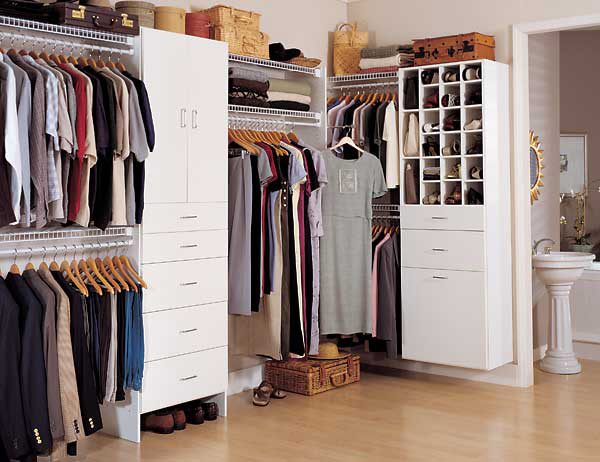
These days, nobody will be surprised by dressing room, specially equipped for storage and adapted for fitting clothes and changing clothes. However, a separate room remains a cherished dream for many people.
Professionals recommend making a dressing for at least 6 square meters. This area allows you to not only place the racks, ironing table and a mirror, but also allow adequate space for changing clothes and even recreation. To separate several meters out a large apartment for dressing room, as a rule, makes absolutely no problems. In houses or in spacious enough apartments is accepted to make several wardrobes: for parents – in the bedroom, and children – near the nursery, sometimes, separate cloakrooms are arranged for each family member.
If the planning of the apartment allows, the most logical place for the “adult” closet is the bedroom, some variants of its arrangement is in the bathroom or in the hallway. If the couple is a need for two cloakrooms, a female can do next to the bedroom, and a man – next to the cabinet. A good option is a passing wardrobe installation, which is located between the bathroom and bedroom, but this option is only suitable for apartments with at least two bathrooms.
The question of individual wardrobe installation in small apartments does not have a clear answer. On the one hand, by leading a place in the dressing room, we “eat” a few precious feet, on the other, placing the dressing room not only clothes and shoes, but also bedding, ironing table, vacuum cleaner, etc, can help us to exempt other placements from these things. Proper storage not only contributes to the maintenance of order, but also makes it possible to visually “unload” the space of an apartment, and thus make it more spacious and bright. For small apartments, the best option is the arrangement of a dressing area in 4.3 sq. m. And surprisingly, in a room measuring 1.5 by 2 meters can fit a lot of things.
Angular closets, which also give the opportunity to place the furniture in the room in nonstandard way are also popular. A successful solution is a placement of a dressing room in a deep niche.
If a professional designer finalizes your apartment, he will offer you a choice of options for the mini-wardrobe installation. As a rule, architectures and designers when planning a wardrobe, skillfully mask the wardrobe with decorative wall and embellished it with the opposite side resulting perfect interior view.
To make the dressing lighter, you do not need to raise a partition that separates it from the bedroom up to the ceiling; it will allow the daylight to penetrate into the enclosed space.
If you are accurate enough and the content of the items in the order is not a great complexity for you, then you don’t need to hide the wardrobe behind a wall or a door mat, but instead effectively put on display locating behind a transparent partition made of glass. You can separate the cloakroom from the bedroom only conditionally, setting the border zones of high chest of drawers or bedside, or hide the clothes of a decorative curtain, chosen close to the tone of textile decoration of the bedroom.
Filling the cloakroom depends on your wishes and financial capabilities. A lot of western and native companies offer cabinet type furniture for wardrobe installation. There is an option, when metallic guides are strengthen to the wall, so you can stick shelves, racks, wire basket at any best for you combination. Lightweight metal racks on rollers will also fit, which can be pulled out as needed or, conversely, move in a more compact design.
Wood pulp, laminate, veneer, glass, mirrors, plastic, wallpaper, fabrics are used in cloakroom design. In this part of the decoration of the apartment, no regulations exist: it is a private room, and here you can give vent to your imagination.
