Technological Interior Design: Plilippe Starck
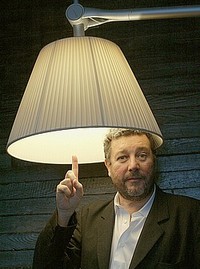
Philippe Starck is known for his love to technologism. Philippe Starck is an “originality of constructive decisions”, an ingenuity, staginess, wit often adjoining to irony.
The name of Frenchman Philippe Starck is known to all who, anyhow, is connected with design art or at least watches tendencies of modern design. The future star of world design and architecture was born on January, 18th, 1949 in a family of the aircraft designer. That had an impact on a choice of activity of Philippe Starcklater on. Designing has carried him away since the early childhood. However, besides the technical aspect, the love ofcreation of original designs was combined in him with wide creative potential, not ordinary art abilities. The addiction to art and creation of effects took Phillippe to the well- known Parisian School Kamondo where he got his education as an interior designer.
Already in 1968 Philippe Starck founded his first design company which was engaged in creation of inflatable advertising installations. Starck’s original ideas have attracted the attention of many “coryphaeuses” of design, and in 1969 it has broken to cooperation with Pierre Cardin as a designer-illustrator, projecting unique, innovative models of furniture. Later Stark founded his own design company “Starck Product” which was not only engaged in interior deisgn, but also industrial design.
By his thirties Starck was considered as a rising star not only in the French, but also in the world design. In the eighties of the 20th century he was known to be a master of design and architecture.
Unlike many designers, whose interests and creativity were not beyond one certain kind of activity, Philippe Starck has shown himself in various areas, creating original trifles of a life, along with designing large architectural ensembles.He hazardously projected furniture, lighting devices, tooth-brushes, boats, bottles for mineral water, kitchen devices, street lanterns, door handles, crystal vases and even forms of pasta for known European, American, Japanese brands. Thus he created design of a torch for winter Olympic Games of 1992. He was the author of an exposition «30 years of the French design 1960–1990» in Pompidou’s Center, has received 15 prestigious international awards for the works in the field of designing of furniture andinterior design.He is the Gentleman of the Award of the literature and art, and also has the Légion d’honneur of France.
And in all areas of the activity he has proved himself as an innovator, a designer, whose style became recognised all over the world regardless of the fact of what it represents to the public. Formally Philippe Starck’s style is called postmodernistic.However he said several times that he did not accept the onditional division into styles and directions which limit creativity freedom, imposing the artist to certain frameworks and criteria. Philippe Starck’s own style is shown not only in his works, but also in his behaviour, a way of life. Vigorous and provocative, he at times behaves as a madman, shocking public with ambiguous statements, ostentatious tricks.
However at the same time he gushes with ideas which, being embodied in a life, always find their way to the consumers’ hearts.Taking into consideration the fact that he manufactures consumers goods in series, you can tell without exagaration, that his products are bought not only by a narrow circle of judges of unique things, but also by a wide layer of simple people who have an opportunity to decorate their lives with original accessories from the master of the modern design.
As characteristic features of design of Philippe Starck consider propensity to технологизму, Philippe Starck is an originality of constructive decisions, an ingenuity, staginess, the wit often adjoining on irony.
Thus Starck inherents both minimalism, and effective excessiveness. The things developed by him are always working for “hooking” on human emotions, to surprise, intrigue, and epotage. Stark likes to play with spectators, by entertaining them with technological truicks: the lamps soaring in air without any support, wonderfully disappearing folding tables and chairs. It is interesting that this provocation bears only a positive emotional charge, forcing us to feel more deeply and more often to reflect on the nature of things.
