Cutting a Cope Joint on Crown Moulding
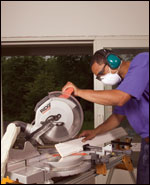
In theory, at least, you could miter crown moulding when two pieces meet in a corner. In fact, however, it would be a disaster. Crown only touches the wall at two points–the top and the bottom–so the vast majority of the joint is floating in midair, making it impossible to get a tight seam. Coping the corner pieces solves the problem. Here’s how it works: One moulding runs into the corner of the room, where it meets the wall with a simple butt joint. It supports the second moulding, the end of which is cut to fit against the first molding like a piece of a jigsaw puzzle.
Putting the first moulding in place is a matter of cutting a butt joint and nailing the moulding in place. Cutting the second moulding to fit against it begins with a miter cut that makes it easy to see the shape you need to cut. You then cut along the shape with an inexpensive handsaw called a coping saw. Make sure you’ve got a fine blade in it (check it against a pack of replacement blades if you’re not sure.) You’ll also need a stable work surface one to three feet above the ground–a toolbox or sawhorses will do, but a platform like the one shown here supports more of the moulding and is easier on your back.
Despite appearances, this is not a hard joint to learn, but practice helps. Buy an extra piece of moulding before you start, and cut a few practice joints. It will give you confidence, and you’ll get to throw out your mistakes instead of hanging them on the wall for all the world to see. The next few pages show you how to cut the end of one molding to fit against the other.
