Countertops
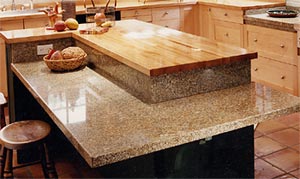
Though we’ll never stop preaching the importance of selecting your cabinetry first, there’s no denying it: that perfect countertop
But with so many fish in the sea, it’s important to approach the selection process wisely. You know what these countertops look like; now it’s time to get a handle on their individual characteristics. Read on to learn about specific costs and pros and cons before you make a countertop commitment.
The brief overview:
Practically speaking, solid surface, natural stone and quartz tend to hold up best. If you spill something, hope it lands on solid surface, quartz or stainless steel. You want to roll dough on marble and cut on stone or wood. Laminate and solid surface come in the widest variety of colors. The flexibility of solid surfacing and stainless steel makes them ideal for fashioning decorative shapes or integral sinks. Once sealed, concrete functions as an excellent surface that’s quickly gaining in popularity.
Tile, wood and stainless steel offer special looks but have their tradeoffs: tile doesn’t offer a smooth surface for food preparation and its grout can discolor; wood requires sealants and maintenance; and steel scratches and shows fingerprints. Specialty surfaces like hemp-based countertops and those fashioned from lavastone provide alternative choices outside of the countertop norm.
You can achieve the best of all worlds by carving out space for a mix of surface materials—a granite island for serving, a maple butcher-block square for cutting, solid-surface tops for heavy food-preparation tasks and tile for a backsplash accent.
