Interior Design Fusion
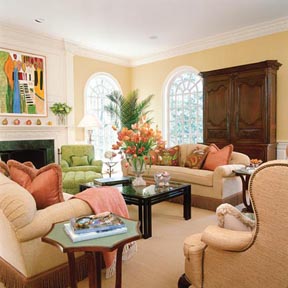
Fortunately, the homeowner, who enjoys the unexpected juxtaposition of contemporary art with antiques, partnered with interior designer Ann Kenkel of Washington, DC-based Ann Kenkel Interiors, who admits she finds the combination refreshing. “Through long discussions with the homeowner, I understood that she had a great love of contemporary art, some classic contemporary furnishings, which were art pieces in themselves, as well as antiques,” Kenkel says, recalling their initial long-distance collaboration. “I asked her to send me pictures of their current house so I could see what they had and what they liked. I also asked for pictures of every single piece of furniture, art and accessory so that I could begin planning the placement of all their items.”
The fusion of design styles played a vital role in the ultimate success of this project, especially considering the extensive collection of art and furniture the homeowner had gathered over the years. “I think a great example [of the design fusion] is my dining room,” says the homeowner. She was understandably skeptical about how her contemporary George Nakashima walnut dining table would complement the room’s elaborate moldings and Jeffersonian-inspired triple arched passageways or her beloved antiques, which include a linen press she purchased while living in London.
“If you are going to put traditional with contemporary, you have to have a few transitional items, which you can use to connect them in a myriad of ways,” explains Kenkel. Rather than utilize the contemporary host and hostess chairs from the homeowners’ California home, the designer instead found transitional wing chairs to bridge the design gap. She selected a chocolate-hued grass cloth wallpaper to complement the organic shape of the table, but balanced the earthiness with more formal elements
Ann Kenkel masterfully blended periods and styles in the living room; her clients’ modern paintings provide focal points on the walls.
including a Tufenkian rug woven with subtle shades of mocha, sage green and coral, as well as Schumacher silk draperies with an iridescent copper dragon pattern.
Kenkel faced similar challenges in the living room. “It is a long room requiring many pieces of furniture, a focal point for each wall and elements to make it cohesive,” she says. “The strong character of the contemporary art and the heavy plaster moldings begged for there to be pieces of furniture that were ‘art’ or had architectural components, but they all had to be integrated perfectly for the room to work as a whole.”
