Walls Of Glass: Glass Bricks In The Interior
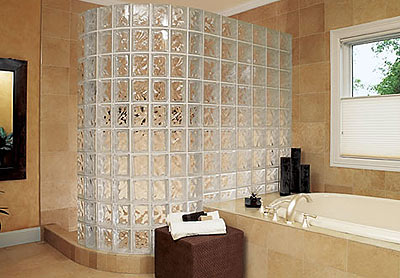
If you mention the word “glass bricks” many people remember dismal walls of bottle-green color, which were erected in hospitals, swimming pools, baths and entryways. Extensive use of glass blocks spoke, of course, not about the aesthetics, but their operational properties.
Thanks to its unique properties, glass did not remain in the past, but on the contrary, it suddenly came into vogue, becoming a modern, demand in the construction and decorative materials. The reason is simple: the glass blocks are not only functional (high impact, insulate sound, keep warm, do not burn in the fire), but also can play a significant role in the decoration of the room, especially now that manufacturers offer the widest range of glass blocks in design, color and texture. Whereas, a tendency of modern interior design, aimed at creating spacious and bright rooms, opens new perspectives in the use of glass blocks in the interior. This unusual, beautiful decoration material changes the space and makes it airspace and light, and a large selection of colors and patterns allow you to choose the best solutions and combine them on your own, creating a unique stylish design.
Modern glass bricks are building material that are truly amazing. Glass bricks are the product of a hermetically sealed cavity, formed by combining two pressed glass plates. Each half is made of thick glass (6-9 mm.). The shape of the glass block looks like a brick; just inside this “brick” is hollow. The wall of these blocks with thickness of 80 mm can easily “argue” for its thermal and sound insulation characteristics of a wall of brick, laid in a “two bricks”. The secret of such a low thermal conductivity and high insulation is that the production of glass blocks in their cavity is formed almost rarefied space. In addition, the glass is not inferior to brick in the ability to easily transfer and the low and high temperatures, and therefore, can be used as fully as the exterior walls, and as their fragments. Glass is not afraid of water, so is ideal for designing the pool, bathrooms and other rooms with high humidity. Glass bricks transmit light, but they have certain advantages over ordinary glass. Their surface can be transparent, opaque, corrugated, color. This will determine how much light and how it will pass through the barrier. Transparent glass lets around 85% of light through it. For such a wall, you will not feel like in an aquarium. Glass bricks with a matte surface let about 50% of light; the same can be said about the colorful one. If the glass in a block is corrugated, the location facets will determine whether it will light-scattering or light directing. The walls of glass blocks, unlike brick or plasterboard, don’t need to paint or plaster, or wallpaper. They do not require special care: it is enough just to wash. In the Russian market, the following glass manufacturers are represented: Vetroarredo (Italy), Vitrablok (Czech Republic), Vitrosilicon (Poland), and industrial glass (Bryansk, Grodno).
