Interior Design: Minimalism
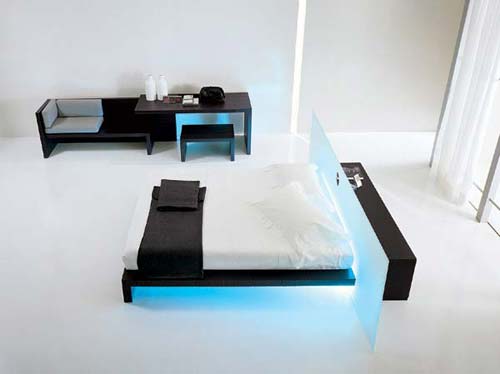
Extremely concise form, complete absence of decoration, ornamentation or detailing facade decoration. Clarity of composition, monochrome, pedaling natural textures. Work with big planes, graphic quality.
Minimalism, in its extreme expression, seeks to completely eliminate the use of decorative items, believing that for architecture walls and roof, and interior – bed and table are sufficient. The minimalist building, however, can be rather complicated configuration dictated by the nature and possibilities of the material. Modular concrete structures, which brought into vogue Japanese architect Tadao Ando, suggest a strict, geometric approach, and the use of reinforced concrete can embody the plastic and at the same time concise form. But in any case the basic requirements should be met: regardless of the complexity of the task there must be minimal (at least in appearance) means. No frills, parts or complex decoration work.
It is desirable that even structural elements were hidden, not conspicuous. All the attention is given to the three-dimensional solution, and its perfection does not need more decoration. To a large extent there is no interior for the minimalists, rather, the best interior design is its absence. Decoration work is the most primitive, at best paint on the walls and parqueted floor. Precondition – monochrome, graphic quality, an abundance of free space. The most necessary furniture with simple outlines is only allowed. Ideal version is an empty room in which there is a lonely bed, or desk with a chair or sofa with the TV. All functional elements that do not possess sufficient integrity and sterility of forms, are hidden behind partitions. The only acceptable decorative inclusions are art objects, placed the way that nothing prevents enjoy their contemplation.
With this lapidary approach, the main instrument creating character and mood of the interior is light. Natural light at different time of a day and various types of artificial lighting should be thought through carefully. After all, the light is able to revive and transform the space.
