Japanese Interior Design
 Japanese culture is unique and different, like no other and this mystery and mysticism attracts us in Japanese painting, art, creativity.
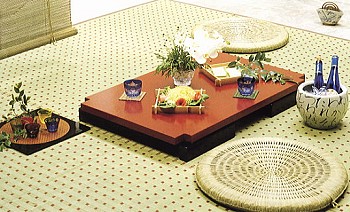
Japanese furniture is attractive in its simplicity, lightness, grace, and above all – mobility. One of the main objects of the interior is tatami- a mat made of straw. These mats (their size is approximately 180 cm x 90 cm) cover the entire floor in the room. Tatamis are usually replaced for new ones more than once every two years. You can walk barefoot on such surface. If you put a small mat on the futon – Japanese cotton mattress – you’ll get a simple and comfortable bed, which can be quickly removed if it is necessary.
A traditional kind of Japanese furniture is the Tansu furniture. It appeared in the first half of XVII century, in the Edo period. In Japanese Tansu means “box”, which is a place for storing things. All the furniture – cupboards, chests of drawers, trunks were made of precious wood, they were varnished and were rather expensive. The woods of hinoki and sugi trees and solid reeds were usually used. Trunks and chests for storing clothes were made of Kiri wood, because it absorbs moisture well. According to the owner of this furniture one could judge about the social status of the owner.
 Space, details and lighting are important components in the Japanese interior. For example, often with the help of shoji (a screen consisting of wooden framework and rice paper stuck to it), the space is divided into zones, and then these areas are decorated with certain decorative elements.
Many things should be and are multifunctional. A beautiful lacquered table serves both as a dining table and a decorative element. Instead of doors the Japanese prefer norens – a curtain closing the door aperture made of 100% cotton with a colorful stencilled image.
It is hard to imagine a Japanese house with no ikebana or bonsai trees. Traditional Japanese decors for homes are vases, dolls made of wood, bronze statuettes of saints, scrolls and elegant china.
