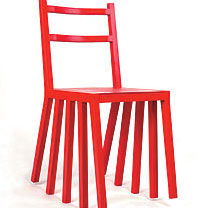
Chair With Ten Feet
The London exhibition 100% Design is different from the Milan and Paris furniture showrooms, just as London Fashion Week from the Milan and Paris ones. Protagonists of 100% Design are recent graduates, who a few years will set the tone in the design and make projects for monsters of furniture industry. It is a glimpse into the near future and is interesting because of the London exhibition.
It should be said that the future looks quite good. Compared to commercial exhibitions, where the marks appear, if not all together, but quite smoothly, 100% Design, representing works of young designers and small studios, is less homogeneous, but you can catch the tendency. And even draw a sort of composite picture of the future of interior.
Furniture
The young stakes on modest furniture in the spirit of 50’s. The materials are mostly wood and plywood, colors are clean and bright, the sizes are delicate, like the furniture to fit into small apartments. However, designers do not blame the lack of own ideas. “Freshness” is achieved at the expense of interesting shapes or unusual combinations. One of the most popular collections at the exhibition was a young British Series X marks Outgang: a variety of items from bent plywood, similar to origami. On the one hand, it is in the spirit of 50’s, on the other, it is much more graphic quality and multifunctional (furniture can turn over and be used as a chair, then as a footrest, if not a table). In the same vein, were made by the Belgian Nicolas Bovesse, British Derek Welsh and Burnt Toast, the Swedes InForm, and many others, who created furniture from traditional wood, but non-traditional forms, beating all the possible geometric shapes. Along with the tree (and sometimes instead of it) metal and glass are used, which further emphasize the fashionable “skinniness”. Slim Jim coffee table with wooden top and curved metal legs of Rob Dean Design gave this trend the name “slim-jim” (“skin and bones”). The tables from the series Trace Naughtone are perfectly fitted into it. Glass enclosed in a metal frame – it would seem straightforward manner, but the designer Stefan Bench invented painted metal in bright colors, making tables look quite cheerful. Designers generally actively use colors (and even figures), to revive their incorporeal models. Glass top table from a simple Leonhard Pfeifer of the association of designers Hidden Art is covered with baroque ornaments, table Index Lithuanian stamps Contraforma simulates the map, chairs the English Office Art Meets Matter painted flowers in the spirit of some sort of shawls, etc.
Upholstered furniture is also clearly “set on a diet”. Harsh sofas on legs, modest wooden chairs with armrests or even without them, low stools, all these are too much in the spirit of the 50’s. They can’t be called boring because of their bright lining or interesting details. Chair with one armrest from a Belgian studio Lamaisondemarina is combined with a floor lamp. Model Karicom Japanese brand Karimoku praised to the skies by the critics, is a real couch of 50-ies, upholstered fabrics lovely youth company Mediacom Toy. Snow-covered mountain peaks (presumably Fuji) and goggle-eyed creatures oval (presumably beans) are really enliven a very strict sofa. Admiration of the public can be called the model of Lithuanian stamps Sedes Regia and Contraforma, a little bit singling out from the general background. New chairs and sofas Sedes Regia are the constructions of soft cushions and parallelepipeds. Contraforma presented a good collection, but chair Ku-dir-ka ten feet which supposedly began to dance, and the rocking chair Mom, covered with gray felt with a yellow motif (a rare case of literacy use in the design of people’s motives) were particularly distinguished. English designer Ryan Frank of Hidden Art showed another curious nice “rocker”, but not an armchair, but a chair, and not soft, but made of plywood. And then, guys from the Canadian studio Molo came up with their solutions. Their entire Soft collection, including seats and walls, were made of something like cardboard. Furniture, if it can be called so, is sold as flat packs, and, when turning, it can take many forms. This is weird, but very practical idea of the museum said MoMA, including Soft in its permanent collection.
